
“When will my child be ready for the grade 1 piano exam?” This is the most common question that I get from parents. The answer isn’t one-size-fits-all, but here’s a thoughtful breakdown to help set realistic expectations and support your child’s musical journey.
⏳Typical Timeline
- Average Range: Most children take 18 to 36 months from their very first lesson to reach Grade 1 readiness.
- Younger Beginners (ages 5–7): Often closer to 2.5–3 years, due to developing fine motor
skills, reading fluency, and attention span. - Older Beginners (ages 8+): May progress faster—sometimes reaching Grade 1 in 12–18 months, especially with consistent practice and prior musical exposure.
*note that the above timeline is just a general guideline to the amount of time required to reach grade 1 in each age range. Whether or not a child’s progress can fit into this timeline will still depend on other factors like the ones listed below.
🧠Factors that Influence Readiness
- Age and Maturity – Younger children may need more time; children who are more mature may learn faster.
- Attention span – Children with shorter attention span will a take longer time to learn the same things as those who are more focused.
- Practice routine and amount of practice – Children with a fixed practice routine (daily practice of 15-30 minutes) progress faster than those who practice sporadically. Those who practice 1 hour a day progress faster than those who practice only 10 minutes a day.
- Lesson Frequency – Usually, weekly lessons are ideal. But there are those who practices more and opt for twice-weekly lesson to get more regular feedbacks on their playing, and they progress faster. Bi-weekly or ad-hoc lessons are not recommended for beginner or intermediate students.
- Parental Support – Children whose parents practices with them progresses faster. It is recommended for parents of young beginners to sit in the lessons and/or at least learn some basics to help their child in his/her practice.
🎯What “Ready” Really Means
Grade 1 isn’t just about playing three or four exam pieces. A well-prepared student should also:
- Read both treble and bass clefs fluently
- Demonstrate steady rhythm and musical phrasing
- Play scales and arpeggios with correct fingering
- Handle sight-reading and aural tests confidently
- Understand basic music theory (key signatures, dynamics, intervals)
Before a student can do all of the above, he/she should have a firm foundation at the beginner stages. Here is a detailed description of the skills that one needs to attain at each level before attempting the grade 1 exam.
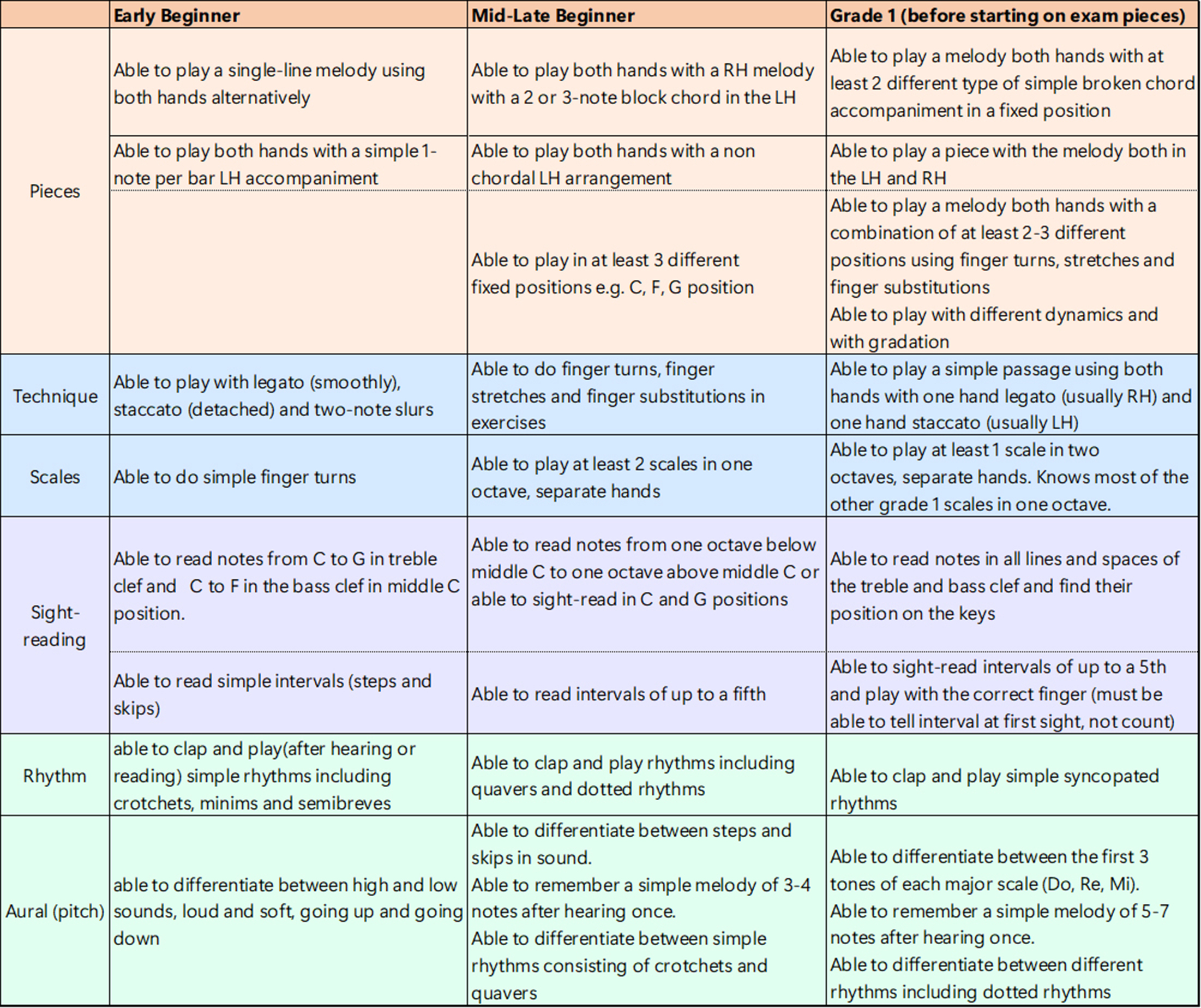
*LH = left hand, RH = right hand, BH = both hands, SH = separate hands
*For grade 1, it is not necessary to have all the skills listed as some will be taught while learning the exam pieces, but student should have at least most of the skills. For each pre-grade 1 level, students should at least finish 1 book and be able to play at least 3 pieces from that level fluently (performance standard) – that means accurate notes and rhythm, even speed and tone, and confident playing.
*Note that the requirements stated above are only requirements for a secure pass in the Grade 1 exam, not a distinction.
📘Pre-Grade 1 Options
Many teachers use Initial Grade or Prep Tests as stepping stones. These help to:
- Build exam familiarity
- Boost confidence
- Identify readiness gaps before Grade 1
Tips for Parents
- Celebrate progress, not just exam milestones
- Listen to the exam pieces regularly to build familiarity
- Encourage performance at home or in studio recitals
- Avoid rushing—a strong foundation leads to long-term success
Summary
The amount of time stated to complete each level above varies from child to child. This is not only due to how fast each child learns but all the other factors stated above. I personally have six year olds who took less than a year to be ready for grade 1 exam and older children who took years to be ready for the exam. ABRSM suggests 1.5 years to be ready for the exam, but this is only for an average child starting at around primary school age who has sufficient practice and parental involvement. However, if your child practices regularly and if you made sure that your child learns and becomes natural in every skill that is taught (including sight reading) without much delay, he/she will not take too long to be ready for the grade 1 exam, and may even be faster than average.
There is some strong research that suggests it takes on average, 3,300 hours to reach and achieve Grade 8 level, regardless of whether a pupil goes on to be a high musical achiever or not. What’s more, the same highly respected research team estimates that to achieve Grade 1 level takes ALL LEARNERS… approximately 450 hours of practice!
Grade 1 is often the first formal milestone in a child’s piano journey, but it’s also a reflection of everything they’ve learned along the way. Whether it takes one year or three, the goal is to nurture a love for music and build skills that last a lifetime.
Here is a video of my student playing a piece at ABRSM grade 1 level
Here is a video of what to expect on the exam day for ABRSM exams
https://youtu.be/kcYpWvG0NZ8
Click here to see my student’s achievements for past-year ABRSM exams.
If you think that this is worth it, buy me a coffee
You might also like to read
Common Misconceptions about Learning Piano
What you need to know about ABRSM Exams
How to get a distinction for ABRSM Performance Grade Exams
ABRSM Marking Criteria
Aureus Music School Piano Lesson Aureus Academy Yamaha Cristofori Mandaville ABRSM Singapore Tampines NAFA SYT Piano Teacher Lasalle SOTA Yong Siew Toh The Happy Pianist Aureus Conservatory Kawai Music School Steinway STEP Steinway Singapore

 My Piano Teacher
Leave a reply to AC200675 Cancel reply