My Sight Reading Journey
When I first began learning violin at six years old, my mum often nagged at me to look at the score while playing. At that age, I was too young to understand her intentions, and the advice felt more like a distraction than a help.
Years later, when I started piano at eleven, she repeated the same reminder. This time, I confidently replied that concert pianists don’t look at the score when they play. While technically true, I completely missed the point. Concert pianists already possess strong sight reading skills—they can afford to play without the score because they’ve internalized the music. Their freedom comes from mastery, not avoidance.
Throughout my piano learning journey, my sight reading remained weak. I had a good ear and could learn pieces quickly, but my teachers didn’t emphasize sight reading, so I leaned heavily on listening and memorization. When I reached higher grades, the pieces grew more complex, and my lack of sight reading ability caught up with me. I managed to prepare for Grade 8 by listening repeatedly to recordings and piecing the notes together bar by bar, but ingrained errors crept in—mistakes that came from not truly reading the score.
It wasn’t until I began teaching that my sight reading started to improve. Guiding students forced me to confront my own gaps, and over many years, I gradually built the skill I had once neglected. Today, I recognize sight reading as one of the most essential abilities for pianists—not just for ensemble playing, but for independence, accuracy, and musical fluency.
🌟 Why Sight Reading Matters for All Musicians
- Musical literacy: It transforms notation into sound fluently, much like reading aloud from a book.
- Efficiency: Speeds up learning new repertoire.
- Confidence: Reduces anxiety when faced with unfamiliar scores.
🎹 Why Pianists Need It More Than Others
1. Polyphonic Complexity
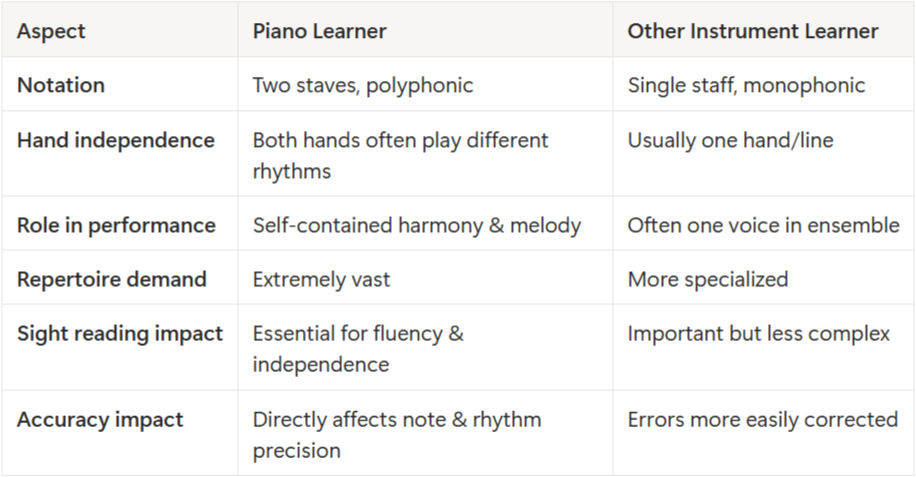
- Unlike most instruments, the piano demands reading two staves simultaneously (treble and bass clefs).
- Pianists must process multiple voices, harmonies, and rhythms at once, often with independent hand movements.
- Good sight reading trains the brain to recognize vertical structures (chords) and horizontal flow (melody) instantly.
2. Sheer Volume of Repertoire
- Piano literature is vast—solo works, concertos, chamber music, and transcriptions.
- Without strong sight reading, exploring this repertoire becomes slow and limiting.
3. Self-Sufficiency
- Other instrumentalists often rehearse with ensembles or rely on accompanists.
- Pianists, however, are usually their own orchestra, responsible for harmony, rhythm, and melody simultaneously.
- Strong sight reading allows them to learn independently without constant teacher guidance.
4. Cognitive Development
- Sight reading strengthens pattern recognition, hand-eye coordination, and multitasking skills.
- This cognitive workout is more intense for pianists than for single-line instrumentalists.
5. Practical Everyday Use
- Even if not accompanying, pianists often encounter situations where quick reading is essential:
- Playing hymns or songs at family gatherings.
- Trying out new pieces before committing to practice.
- Exploring music for teaching or leisure.
🎯 Note & Rhythmic Accuracy
One of the most striking differences between pianists with strong sight reading skills and those without is accuracy when learning new pieces.
- Good sight readers quickly grasp notation and rhythm, producing a version of the piece that is structurally sound from the very first attempt. Their practice time is spent refining interpretation rather than fixing fundamental mistakes.
- Poor sight readers, however, often misread notes or stumble over rhythms, leading to ingrained errors that take weeks to undo. This slows progress and can cause frustration, as the learner spends more time correcting than creating music.
For pianists, this issue is magnified compared to other instrumentalists. A violinist or flautist, for instance, plays a single melodic line—an occasional rhythmic slip or pitch error can be corrected quickly. But a pianist must manage multiple voices simultaneously, often reading complex harmonies and rhythms across two staves. A single misread note or misplaced beat can distort the entire texture of the music. Because the piano produces both harmony and melody, inaccuracies can be missed and become deeply ingrained if not corrected early.
Strong sight reading ensures that pianists internalize both horizontal flow (rhythm and melody) and vertical structure (harmony) accurately from the start, laying a solid foundation for expressive, confident playing.
📊 Comparison: Piano vs Other Instruments
Final Takeaway
For pianists, sight reading is not just a skill—it is a survival tool. It unlocks independence, accelerates learning, and makes the vast piano repertoire accessible. Even those who never plan to accompany or play in ensembles benefit enormously, because the piano’s polyphonic nature demands a higher level of literacy than most other instruments.

